

Northwest Michigan’s housing market is off to a slower and less defined start compared to other regions, with early-year activity impacted by both seasonality and winter weather.
Through February, new listings increased 30% from the prior month, while new pendings declined 13%, suggesting that buyer activity has yet to fully respond as the market transitions into spring. This imbalance points to a market still in the early stages of seasonal momentum.
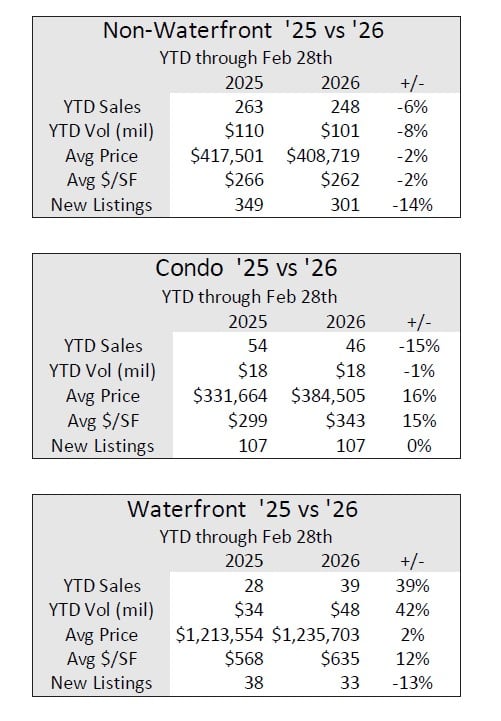
Unlike Southeast Michigan, where inventory trends are driving conditions, Northwest Michigan’s story is more about timing. While waterfront markets typically gain traction later in the year, this year’s waterfront activity has started stronger than last year. Even so, the segment has not yet reached its peak seasonal pace.
Outside of waterfront, early-year activity has been more mixed. Non-waterfront sales are down compared to last year, with modest pricing pressure in that segment. Condo sales are also lower, but average prices and price per square foot are up—likely reflecting a smaller number of higher-end transactions. Together, these trends suggest that demand remains selective, with buyers concentrating in specific property types and price points.
As new listings continue to rise in the coming months, buyer activity should follow. The key question will not be whether the market improves, but how evenly that improvement is distributed. Waterfront properties appear well positioned heading into peak season, while non-waterfront homes may face more competition and require sharper pricing and strong presentation.
Sellers should recognize that early-year results are not fully representative of peak-season performance but should also be prepared for a more competitive environment in segments where demand is less consistent. Buyers may find early opportunities in slower-moving segments before competition increases later in the spring.